Blood and Granite by Norman Adams
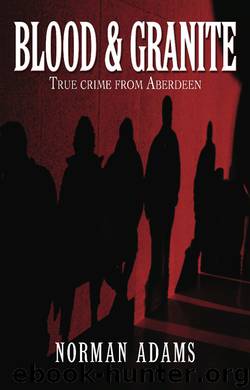
Author:Norman Adams
Language: eng
Format: epub
ISBN: 9781845026325
Publisher: Black & White Publishing
Published: 2012-12-27T16:00:00+00:00
11
BIRTHDAY TAUNT
1955
On the bleakest of winter Saturdays, William Henry McKerron made his way through Aberdeen’s snowy streets to confront his wayward wife, Alice. Married life had been nineteen months of walk-outs and bitter rows, despite efforts by the merchant-navy man to make it work. It was before nine in the morning of 19 February 1955 when McKerron reached her address in Woodside.
The country was in the grip of terrible weather. Convoys of snowploughs were out in force in the north-east. Grantown-on-Spey had endured 52 degrees of frost, while grave-diggers were forced to use pick-axes. Seven thousand Rangers fans were struggling through drifts for an important Scottish Cup tie at Pittodrie.
As McKerron entered the tenement at 11 Ferrier Crescent, children shouted excitedly as they sledged in the street. Shortly afterwards, housewife Mary Main met McKerron on the stairway. He told her, ‘Fetch the police. There’s been trouble.’ McKerron had killed his wife. It was the day of his twenty-third birthday.
Two days later McKerron, a tall, slim figure wearing a suit and blue open-necked shirt, appeared at Aberdeen Sheriff Court in connection with his wife’s death. Sheriff Sam McDonald remanded him in custody for further examination. Under the original indictment, McKerron was accused of murdering his wife by throttling her. But, when he appeared in the dock at the High Court in Aberdeen on Tuesday 31 May, the advocate-depute, Mr Douglas Reith, accepted a plea of culpable homicide.
McKerron had married Alice Burnett, who was two years younger than him, in July 1953. But, said Mr Reith, she appeared to have been of loose moral character and had apparently consorted with various men, mainly seamen. Their marriage was blighted with quarrels. McKerron had attempted to get her to settle down but without much success. Latterly, they lived apart – although they met from time to time, mainly in pubs. By then, McKerron was drinking fairly heavily.
On the night before the killing, the estranged couple met in a pub. A quarrel developed in the course of the evening and, next day, McKerron called at the first-floor flat in Ferrier Crescent where his wife had sub-let a room from her stepfather, Frederick Burnett. A female friend was also visiting Alice and McKerron said he wanted to speak to his wife alone. Reluctantly, Alice went with him into the bedroom. Minutes later, McKerron left the room, locking it behind him. He said words to the effect that he had strangled his wife. He unlocked the door when police arrived and admitted what he had done. Mr Reith said there seemed to be a possibility of a degree of diminished responsibility at the time of the offence. McKerron’s counsel, Mr Ewan Stewart, said the accused’s culpability was of a lesser degree than might first appear and the consequences of his act were quite unforeseen by him.
Aberdeen-born McKerron came from a broken home, his parents having divorced when he was thirteen. He proved an excellent pupil at primary school – quiet, attentive and patient. His teacher, said Mr Stewart, thought he had the ‘makings of a very good man’.
Download
This site does not store any files on its server. We only index and link to content provided by other sites. Please contact the content providers to delete copyright contents if any and email us, we'll remove relevant links or contents immediately.
Mindhunter: Inside the FBI's Elite Serial Crime Unit by John E. Douglas & Mark Olshaker(9299)
Wiseguy by Nicholas Pileggi(5748)
Room 212 by Kate Stewart(5091)
Hitman by Howie Carr(5059)
Secrecy World by Jake Bernstein(4727)
Killers of the Flower Moon: The Osage Murders and the Birth of the FBI by David Grann(4424)
Papillon (English) by Henri Charrière(4238)
Breaking Free by Rachel Jeffs(4206)
Killers of the Flower Moon by David Grann(4023)
Say Nothing by Patrick Radden Keefe(3965)
American Kingpin by Nick Bilton(3858)
The Secret Barrister by The Secret Barrister(3680)
Molly's Game: From Hollywood's Elite to Wall Street's Billionaire Boys Club, My High-Stakes Adventure in the World of Underground Poker by Molly Bloom(3522)
Mysteries by Colin Wilson(3437)
In Cold Blood by Truman Capote(3365)
Signature in the Cell: DNA and the Evidence for Intelligent Design by Stephen C. Meyer(3116)
I'll Be Gone in the Dark by Michelle McNamara(3065)
Rogue Trader by Leeson Nick(3032)
Bunk by Kevin Young(2986)
